Saturday, 26 September 2015

गाईड : आर. के. नारायण यांचा आणि देव आनंदचाही !

गाईड : आर. के. नारायण यांचा आणि देव आनंदचाही !
आज देव आनंदचा जन्मदिवस आहे आणि हे वर्ष  'गाईड 'चं सुवर्ण महोत्सवी वर्ष आहे.(गाईड ६ फेब्रुवारी १९६५ ला प्रदर्शित झाला) सुरुवातीलाच कबूल करतो की गाईड हा सिनेमा सलगपणे मी कधीच पाहिला नव्हता. त्यातली गाणी किंवा त्यातले काही प्रसंग टीव्ही वर पाहिले होते. कॉलेजच्या काळात आर.के.नारायण यांची ही कादंबरी इंग्रजीतून वाचली होती. ती तेव्हा आवडली होती. आता नुकताच याच कादंबरीचा मराठी अनुवाद (अनुवादिका- उल्का राऊत, रोहन प्रकाशन) वाचला. तेव्हा वाटलं की सिनेमा बघायलाच हवा. म्हणून त्याची DVD पाहिली. हे असं मी पहिल्यांदा केलं- मूळ पुस्तक आणि त्यावर आधारलेला सिनेमा एकाच वेळी बघणं! आणि  पुस्तक श्रेष्ठ की सिनेमा या अनंत काळापासून चालू असलेल्या वादात मला पुन्हा एकदा प्रत्यय आला की पुस्तक निर्विवादपणे श्रेष्ठ!गाईड सिनेमा चांगला आहे. पण त्यापेक्षा कितीतरी पटीने अधिक चांगलं मूळ पुस्तक आहे. आणि मराठी अनुवाद वाचूनसुद्धा मी हेच म्हणेन( खरं तर हा अनुवाद नीटसा जमलेला नाही असं माझं मत आहे. हिंदी भाषेचा नको इतका प्रभाव, काही संपादकीय डुलक्या असे मजेदार भाग त्यात आहेत. त्यावर एक वेगळे लिखाण होईल इतक्या चुका आहेत. पण तो आताचा विषय नाही.) आणि गाईड एक क्लासिक सिनेमा मानला जातो हे देखील मला पटत नाही.कदाचित हे विधान खूपच धाडसाचं होईल का? पण खरंच जितका गाईड एक milestone सिनेमा समजला जातो तितका तो नाही असं माझं मत आहे.
आर के नारायण 

 कोणतेही मूळ पुस्तक वाचून तुमच्या डोळ्यासमोर आणि मनात त्या गोष्टीची, त्यातील व्यक्तिरेखांची एक प्रतिमा निर्माण होत असते. ती गोष्ट तुमच्या मनात रेंगाळत असते. त्या व्यक्तिरेखांचं त्या त्या प्रसंगांत वागणं, त्यामागचा कार्यकारणभाव याचाही तुम्ही विचार करत असता. कुठल्याही व्यक्तिरेखेचा आलेख आणि तिचे तिच्या  परिस्थितीशी असलेले नाते याचाही शोध तुम्ही घेत असता .यात अर्थातच आपले रंगही  मिसळले जातात.आपले अनुभव, आपली मतं, आपल्या भावना, आपले विचार या सगळ्याचा एक समांतर प्रवास वाचनाच्या दरम्यान चालू असतो. आणि पुस्तकाच्या पानागणिक आपण या सगळ्यांत गढून जातो. कादंबरीचं संपूर्ण अवकाश आपल्या मनात अवतरतं.त्या व्यक्तिरेखांना आपण आपल्या परीनं आणि आपल्या नजरेतून बघत असतो. ही सगळी प्रक्रिया घडायला थोडा वेळ लागतो आणि म्हणूनच पुस्तक  जास्त काळ आपली सोबत करतं.सिनेमाच्या बाबतीत हे सगळं घडतच नाही असं मला म्हणायचं नाही. पण पुस्तकात जेवढी आपली involvement होण्याची शक्यता असते तितकी आणि तितका काळ ती सिनेमात होणं थोडं अवघड असतं.
या सर्वसाधारणपणे लागू असलेल्या गोष्टी गाईड या पुस्तकाला आणि सिनेमालाही लागू आहेत. गाईड कादंबरी वाचत असताना राजू गाईडच्या लहानपणीपासून ते तो गाईड होईपर्यंत(त्याच्यातल्या street स्मार्टनेस सह), त्यानंतर तो रोझीच्या आयुष्याचा गाईड होईपर्यंत, नंतरचा त्याचा पझेसिवनेस आणि downfall आणि मग त्याच्यावर त्यावेळेच्या परिस्थितीमुळे  लादलं गेलेलं स्वामीपण आणि शेवटचा आध्यात्मिक डूब असलेला प्रवास ही सगळी स्थित्यंतरं ठळकपणे जाणवतात. आधीचा स्वार्थी, केवळ आपल्यापुरतं बघणारा, सर्व- साधारण राजू ते लोकांसाठी प्राण त्यागणारा राजू ही एकाच व्यक्तिरेखेमधली  खोली पुस्तकातून आपल्यापर्यंत पोचते. राजूचं हे evolution विस्मयकारक वाटतं.हे पुस्तक संपूर्णपणे राजू गाईड च्या perspective मधून आहे आणि त्यात पहिल्यापसून शेवटपर्यंत सातत्य आहे.
सिनेमा करताना मात्र याबाबतीत गोंधळ झालाय की काय असं वाटतं. राजूची सर्व स्थित्यंतरं न दाखवता रोझी आणि राजूचे प्रेम आणि त्यानंतरचे त्याचे अध:पतन हा भाग जास्त आलाय. मूळ कथेपासून तर सिनेमा खूपच फारकत घेतो- रोझीचे आत्महत्येचे प्रयत्न, मार्कोचा स्त्री-लंपटपणा, रोझीने मार्कोला थोबाडीत मारणे या सगळ्यातून रोझीबद्दल जरा जास्तच सहानुभूती निर्माण करण्याचा प्रयत्न करण्यात आला आहे. मूळ पुस्तकात हे असं नाही. तसंच रोझी आणि राजूच्या आईनं एकमेकींना भेटणं, त्यातून तिला रोझीचं पूर्वायुष्य समजणं हे ही नाही. मार्को आणि राजूची  (रोझी नृत्यांगना झाल्यानंतरची ) भेट काय किंवा शेवटी राजू आणि त्याची आई आणि राजू आणि रोझी यांची भेट हे देखील मूळ पुस्तकात नाही. त्यामुळे मूळ कथेपेक्षा खूपच स्वातंत्र्य घेतलंय असं वाटतं. आणि एकूण चित्रपट रोझीकडे झुकलाय की काय असं वाटत राहातं. मला सिनेमा खूप तुटक तुटक वाटला. दिग्दर्शकाचं जे कौशल्य गाणी चित्रित करण्यात दिसतं ते सिनेमाच्या दृश्यात आणि त्यांच्या संपादनात अधिक दिसलं असतं तर एक वेगळा सिनेमा बघायला मिळाला असता. रोझीच्या रोमारोमांत नृत्य भिनलंय पण मार्कोशी लग्न झाल्यानंतर तिचं नृत्य बंदच होतं. तिची ही ऊर्मी ती नागराज बघायला जाते तेव्हा आपसूक बाहेर पडते आणि ती बेभान होऊन नाचते. हा प्रसंग पुस्तकात फार तर एक पान दीड पानाचा आहे. पण सिनेमात तो तब्बल ४-४.५ मिनिटं चालतो. वहिदा रेहमान एक उत्कृष्ट नृत्यांगना आहे म्हणून  इतका वेळ त्यासाठी इतका वेळ दिला गेला का? पाहा हेच ते  बेभान नृत्य-
https://www.youtube.com/watch?v=IJbgi9S7IMo

माझ्या मते वहिदा रेहमान आणि या सिनेमाचं संगीत(संगीतकार एस. डी, बर्मन)  ही त्याची बलस्थानं आहेत. पण याच बलस्थानांमुळे दुर्दैवाने सिनेमाचा समतोल ढळतो. सगळीच गाणी अप्रतिम आहेत. पण खूप जास्त गाणी आहेत. ३-४ गाणी अगदीच अनावश्यक वाटतात. (उदा- गाता रहे मेरा दिल, दिन ढल जाये, क्या से क्या हो गया) शेवटी जेव्हा रोझी आणि राजू भेटतात तेव्हा देखील -लाख मना ले दुनिया साथ न ये छुटेगा हे गाणं background ला ऐकू येतं. त्याने तर अगदी रसभंग होतो. देव आनंदच्या चॉकलेट हिरोच्या प्रतिमेशी खूपच फारकत घेणारी अशी त्याची भूमिका आहे. खरं तर once in a lifetime म्हणतात तशी ! त्याने ती खूप प्रामाणिकपणे करायचा प्रयत्न केला आहे. पण तरी हे प्रयत्न अपुरे आहेत असं वाटतं.
माझ्या दृष्टीने सिनेमाचं फलित त्याचं उत्कृष्ट संगीत, वहिदा रेहमान चं नृत्य आणि तिचा अभिनय आणि महत्त्वाचं म्हणजे सिनेमा बघून लोकांना पुस्तक आणि त्यातील व्यक्तिरेखा  यांचा परिचय होऊन त्यातून लोकांना मूळ कादंबरी वाचावीशी वाटणं!(माझ्याबाबतीत मात्र हे उलटं झालं असलं तरी!)

Tuesday, 8 September 2015

Muße - Das Glück des Nichtstuns

(While doing Adv Diploma in German (2013-14)at Pune University, I had participated in the DAAD essay competition. Though the essay did not get selected, I thought I could convert it in to a blog.)


Die Vergangenheit-
Die Kindheit war die beste Phase meines Lebens, obwohl ich wenige gute Erinnerungen an die Schule habe. Meine Schulzeit war wirklich schlecht. Es war obligatorisch, viele Hausaufgaben, zu  machen. Ich hatte große Angst vor Mathematik. Es gab viel Konkurrenz, um gute Noten zu bekommen. Trotzdem war die Kindheit die schönste Phase. Ich freute mich auf die Pausen zwischen Unterrichten. Mein Lieblingstag war natürlich Sonntag. Ich freute mich immer auf die Sommerferien.Aber warum ? Weil es eine gute Abwechslung von der langweiligen Routine war. Meistens habe ich in dieser Freizeit nichts gemacht. Ich bin einfach geschlafen oder nur im Bett geblieben. Ich habe viel geplaudert.Ich habe viel gespielt. Aber es war keine Zeitvergeudung. Die Zeiten waren unschuldig, weil wir wenige Anforderungen und Erwartungen vom Leben hatten. Meine Welt war klein und kleinere Sachen und Entdeckungen machten mir viel Spaß.  
Die Gegenwart-
Die Kindheit und Schulzeit ist schon vorbei. Ich bin schon aufgewachsen.Aber jetzt ist das Leben so wie eine Schule ohne die Wände. Alles ist  intensiv geworden. Der Schritt des Lebens ist schnell. Trotzdem gibt es viele Ähnlichkeiten mit meiner Vergangenheit und der Gegenwart. Die Hausaufgaben werden durch meine eintönige Arbeit ersetzt. Schlechte Mathematik wird von Geld verdienen ersetzt. Und auch nimmt die Konkurrenz im Leben zu. Ich bin kein Schüler mehr, sondern  spiele verschiedene Rollen im Leben. Die Anforderungen von jeder Rolle sind höher geworden. Ich muss mir viel Mühe geben, um Verantwortungen als Sohn, Vater, Mann zu tragen. Ich bin Arzt von Beruf. Jeden Tag untersuche ich die Patienten und verschreibe Medikamente. Meistens klagen die Patienten über ihre Gesundheitsprobleme. Heutzutage beeinflusst der Stress unseres Lebens. Also muss ich die Patienten beraten, um den Stress zu überwinden. Aber für mich kann das stressig sein.. Das Resultat ist Stress. Dann ist der Abschied von der Routine eine Sehnsucht. Zeit ist unbezahlbar. Meistens habe ich das Gefühl-wenn ich etwas mehr Zeit hätte! Muße ist so wie ein Luxus. Aber ich versuche einen Raum herum mich, zu haben. Obwohl solche Zeiten selten sind, genieße ich diese Freizeit. Und gleich wie in meiner Kindheit, mache ich nichts. Wenn ich einfach schlafe, fühle ich mich wohl. Oder  ich bleibe im Bett mit geschlossenen Augen. Ich brauche niemand zum Sprechen. Trotzdem macht es mir Spaß.  Ich bin wirklich im Frieden mit mir selbst. Es ist eine wunderbare Gelegenheit mit sich selbst, zu kommunizieren. Der Stress geht weg. Bewusst oder unbewusst, ist diese Freizeit ein erneuter Rückkehr in meine Vergangenheit. Dieses Nichtstun ist die Verbindung mit meiner unschuldige Kindheit. Wenn die Umgebung ihre Unschuld verloren hat,dann ist der Wiederbesuch noch wichtiger. Wenn ich mich an die schönen Momente aus meiner Kindheit erinnere, bin ich bereit meine Arbeit weiter, zu machen. Deshalb ist die Bedeutung von Glück des Nichtstuns  mehr für mich.


Wednesday, 24 June 2015

Fun songs of Madan Mohan

Another 25th June, another Madan Mohan anniversary! He would have been 91 this year (born in 1924). There is so much that has been written & said about Madan Mohan, the great music director! He would have been amused by all of this... How one of his compositions-
Hamare baad ab mehfil mein afsane bayan honge
Bahare humko dhoondegi na jane hum kahan honge...
- from the film Baghi (1953) is proving to be prophetically or ironically true now, 40 years after his death!
He has had many film releases after his death (from Mausam, Laila Majnu, Sahib Bahadur to Veer Zara-2004). Some of those films have been successful at the box office- a thing that eluded him for the better part of his career. There are many stage shows to commemorate his birth & death anniversary each year at least in Pune & Mumbai.
There is a website www.madanmohan.in that gives all information  that you would like to know about Madan Mohan including his unheard songs. A few years back, there was even an advertisement featuring Imran Khan & Kalki Koechlin that used his original song from the film Hanste Zakhm, sung by Mohammad Rafi lyrics by Kaifi Azmi- 'Tum jo mil gaye ho'!


So the point is what more could one add to what is already being said about him! But still here am I with few more songs of Madan Mohan! I have tried to explore a different facet of Madan Mohan's music. And it was a sheer joy to do so. I wanted you all to be a part of this journey. That is why this blog! 

You would generally associate Madan Mohan with soulful compositions- ghazals & romantic songs, sad songs etc. He was undoubtedly the King of ghazals. But he also did quite a lot of fun songs- more so in the earlier part of his career, but even sporadically in the later part. Fun songs would not just mean pacy rhythm or a different orchestration, but also different type of lyrics. Coincidentally ( and not surprisingly either!), many of such Madan Mohan songs have Kishore Kumar as singer (or even actor) & Rajinder Krishan as lyricist. We all know how Kishore Kumar was favourite singer of S D & later R D Burman. But from the songs of Madan Mohan, one tends to feel that this musical partnership matched them in quality. One could argue about the few number of songs that they both had together. 


Kishore Kumar 
Rajinder Krishen


The first of the songs is from one of the earliest hits of Madan Mohan- 1956 film Bhai Bhai. The film actually had many beautiful songs- a peppy Geeta Dutt song- Ae dil mujhe bata de & the much revered song in raag Bhairavi- Qadar jane na. But there was another song with unusual lyrics. Sung by Lata Mangeshkar & Kishore Kumar- Mera naam Abdul Rehman, the song featured Kishore Kumar in a Pathani attire & was shot at Hanging garden, Mumbai. Have a look-

When they both worked together later in Manmauji, they used the same lyrics- Ek tha Abdul Rehman. Manmauji as we all know also had the wonderful song- Zaroorat hai.


Then in 1959, they worked in the film- Chacha Zindabad which was produced & directed by actor Om Prakash. Right from the film title, the film appears to be a comedy. (I haven't seen it, but would surely like to) Madan Mohan has had quite a few films in which he had composed ghazals. (Adalat, Jahan Ara for instance)All those were monumental works. But this film has 4 songs which could fit in to the theme that I have chosen. Each one has a different flavour. While the song Ae hasino has prelude music & Kishore Kumar's voice for almost a minute & half before the song actually starts, Kishore Kumar ends the song- Badi Cheez hai pyar Mohabbat in his unique & inimitable style. The song- Bach gaye hum dono has a tonga rhythm but no tonga in the actual song. This song also has all the fun elements & also underlined Kishore Kumar as an entertainer & performer to the core. The second & third stanzas are brilliantly sung by both Lata & Kishore. But the best of the four is the song- Des chhudaye bhes chhudaye. The song actually begins with a small alaap by Kishore Kumar singing on a Tanpura. The mukhda & the 3 antaras are so poles apart from each other that it is almost like 2 different personalities singing them. The song is too hilarious. Just a conjecture- the song features him & the heroine in their respective homes & he singing while she watches from her window. Was this the germ of the film Padosan ?(for which incidentally Rajinder Krishen was also the lyricist, screen play & dialogues writer)

Keep aside Kishore Kumar & then see if you have any other singer with whom Madan Mohan gave fun songs. There are only a few, unfortunately. The rhythm differs so does the tone. The masti element is less. Here is Lata & Rafi from the 1956 film Pocketmar. The song features Dev Anand & comedy actor Gope. 


Mohammad Rafi 
Lata Mangeshkar 

Signing off with another Rafi song, this time with Asha Bhosale from the 1963 film Akeli mat jayiyo. The song features Agha and Minu Mumtaz on screen. Have a look - https://youtu.be/WzqBvz_mGlE


(Those interested could also read my first blog on Madan Mohan, written on 24 June 2013, with the theme- Tandem songs of Madan Mohan.)


Friday, 5 June 2015

(Some) Temples of Goa: A Photo blog

Goa is not just about beaches, churches & the famous temples of Mangeshi and Shantadurga. There is lots more to explore in this small, yet beautiful state. In our recent trip we had an opportunity to visit some of these places. In this photo blog, I would be showcasing some of the temples of Goa. This is by no means a comprehensive & all inclusive blog. There could be many more such temples. Also at the very outset, let me be clear that I am not a good photographer. In fact, all these photos have been taken from my mobile camera. And last but not the least, I am no authority on architecture. So whatever I comment need not have that authenticity. So with all the disclaimers in place, here we begin with the Temples of Goa...

A common thread that runs in most of the temples is the history. Many temples have been relocated. Due to the Portuguese aggression & inquisition, the Hindus had to flee  from the areas of Portuguese dominance to safer places, carrying with them the deities. This was done to prevent the destruction of the idols at the hands of ruthless Portuguese rulers who showed no mercy & persecuted many a Hindu temple.
This history has been displayed at the entrance of the Ganesh Temple at Khandola, just ahead of Mashel.


There are a few essential features of a typical Goan temple. Most of them are seen the Khandola temple. One of those features is a huge 'Sabha Mandap' or a corridor that leads to the main shrine. The second feature is that the dome is at the end of the Mandap & covers only the main shrine & not the entire Mandap. The Mandap therefore needs to have pillars. Just to give an analogy to help you visualize,the entire structure appears like a cruise ship.


The Sabha Mandaps are so large that they could easily accommodate hundreds of people. They are used not just for the annual festivals or yatras, but also for marriage ceremonies. When we visited Khandola, indeed one such marriage ceremony was going on. 
The idol of Lord Ganesh at Khandola is different than what is usually seen....


After the Devki krishna temple (about which I have written in earlier blog) complex at Mashel & Ganesh Temple at Khandola, we went ahead on the Fonda (or Ponda) road. All the vehicles were lining up to visit the famous Mangeshi temple at Priyol. We had seen it earlier & by then it was already 1 pm . We thought the temple might be closed for the afternoon. So we decided to skip it & went ahead. Just about a kilometre behind Mangeshi, there is another beautiful temple- the Mahalasa Narayani temple at Mhardol. . It was worth the visit as we found another few characteristics of typical Goan temples over there. At the entrance there is a tall, tower-like structure called- 'Deep-mal' or 'Deep-sthambha'. This is meant for lighting lamps on special occasions. Lighting the lamps placed in the notches in the tower must be a task by itself. They would obviously start lighting it from top to bottom.
 

This Deep-sthambh is a common phenomenon at the temples. But in this temple, just next to it, we saw a tall Samai, again a traditional lamp. This was made of brass & almost was of he same height as the sthambh. 


The Mhardol temple is beautiful & according to me, it looks  somewhat like a Pagoda.


We stayed at Arpora. From there, on the way to Anjuna beach, we found a temple at Hadfade. The Deep stambha was lighted with electric lamps. But it gave an idea how the above tower would look like when lit...
 

In a small village Bori, we found another temple with all the essential features. I don't know if this is an essential feature-but most of the temples are painted yellow or pinkish red or shades of red from the outside.Have a look at this-


This is the Navdurga temple at Bori.

But the temple that is simply breathtaking is the Mahadev Temple at Tambdi Surla- which is not far from the Goa- Karnataka border, almost 65 km from Panaji. Not just the temple, but the road that takes you there is also very refreshing-lined on both sides by lush green trees & at times you get a feeling that you are passing through a dense forest. It is indeed situated in the north east part of Bhagwan Mahaveer Sanctuary & Mollem National Park. Its location in the forest was the main reason that it survived Portuguese attack. It has remained intact & is indeed a sight to behold.


It is said to be the oldest temple of Goa. There are conflicting opinions as to who built the temple. The local people would tell you that it was build by the Pandavas when they stayed here during their exile. When you search for the information, you get a different information- that this is built in Hemadpanthi style (between tenth to fourteenth century) & is considered to be the only specimen of Kadamba-Yadava architecture in basalt stone preserved and available in Goa.

 There are intricate carvings on the pillars, ceilings & also the main structure from outside...


This is a temple of Lord Shiva & a large number of devotees throng this place during the annual Mahashivratri festival. But at least when we were there, this place was so calm & serene...
Hardly any tourists... No rush... No standing in queue... In fact is good that not many people know of this temple or even if they do, they don't take the pains of reaching here...Or else by now this splendid work of architecture would have been spoiled  by all sorts of tourists coming there....


Wednesday, 3 June 2015

बकुल गंध मोहरे ….

२००९ मध्ये गोव्यात आलो होतो. तेव्हाचे चित्र मनात अजूनही अगदी फिट्ट बसले आहे. माशेल गावात शिरल्यावर डावीकडे वळायचं आणि रस्त्याचा उतार संपला की उजव्या हाताला दिसतं पिंपळाचं मोठं झाड… झाडाभोवती पार ! तुम्ही झाडाकडे पाठ केली की तुम्हांला तुमच्यासमोर दिसतं ते देवकी-कृष्णाचं देऊळ ! थोड्या पायऱ्या चढून तुम्ही देवळाकडे आलात आणि मागे वळून पाहिलं की पुन्हा ते झाड तर दिसतंच, शिवाय तुमच्या डाव्या हाताला दिसतं अजून एक देऊळ- गजांतलक्ष्मीचं आणि समोर आणखी एक- शांतादुर्गेचं ! आणि झाड आणि ह्या देवळांच्या मध्ये एक मोठं मैदान ! हा सगळा panoramic view डोळ्यासमोर आहेच… शिवाय त्या झाडावर बसलेले पक्षी - गडद पिवळ्या रंगाचा  हळद्या (Golden Oriole )चा ३-४ पक्ष्यांचा थवा ! त्यांचा तो सुमधुर आवाज ! तेही सर्व आठवतं !  एवढे Orioles एकावेळी  एकत्र मी कधीच पाहिले नव्हते. एवढं सगळं आठवण्याचं एक कारण म्हणजे हे आमच्या वृंदाच्या माहेरचं कुलदैवत हे तर आहेच ! पण हा सर्व अनुभव डोळे, कान आणि नाक या senses नी पुरेपूर घेतला होता म्हणूनही तो स्मरणात असावा ! 

यावेळी २८ मे ला आम्ही तिकडे गेलो. बाकी सगळं जवळजवळ तसंच होतं. का कोण जाणे, पण  देवकी-कृष्ण देवळाची रया जरा गेल्यासारखी वाटली. मुख्य देवळावर लिहिलेला माशेल शब्दही अर्धवट पडून गेला होता. खरं तर असं का व्हावं कळत नव्हतं. देऊळ परिसरात बांधकामाचं सामान इतस्ततः पडलं होतं. कदाचित मंदिराचा जीर्णोद्धार होईलही. पण आताच्या स्वरूपात देऊळ अगदी निस्तेज दिसत होतं. आत मुख्य मूर्ती आणि त्याच्या आजूबाजूची सजावट मात्र सुरेख होती. आपल्याकडे खूपच कमी ठिकाणी देवकी आणि तिच्या कडेवर श्रीकृष्ण अशी मूर्ती बघायला मिळते. हे देऊळ त्यापैकी एक ! 


 देवकी-कृष्णाचं देऊळ

देवळातल्या छतावरचं कोरीव काम 
देवकी कृष्णाची मूर्ती 

मनात सारखी मागच्या वेळी काय पाहिलं होतं आणि आता ते कसं दिसतंय याची तुलना सुरु होती. तेव्हाचे orioles अर्थातच आता दिसणं अवघडच होतं ! मग अजून काय होतं ? आणि मग एकदम लक्षात आलं- २००९ मध्ये या परिसरात बकुळीचा मंद सुवास येत होता. आणि अहो आश्चर्य ! आताही तो तसाच जाणवत होता ! फक्त तो कुठून येत होता हे काही कळत नव्हतं! कारण देवळाजवळ कुठलंच झाड दिसत नव्हतं. न राहवून शेवटी मी तिथल्या ऑफिस मधल्या माणसाला विचारलं- " इथे बकुळीचं झाड आहे का?"  ते म्हणाले- "हा वास येतोय तो त्या बायका फुलांच्या वेण्या विकतायत तिकडून! आणि झाड म्हणाल तर ते समोरच्या देवळाजवळ आहे !" आणि आम्ही पायऱ्या उतरून पाहिलं तर खरंच बायका फुलं  विकत होत्या त्यात बकुळीची फुलंही होती. मग आम्ही ते झाड शोधायला गेलो. समोरच्याच बाजूला गजांतलक्ष्मी देवळाच्या बाजूला ते झाडही सापडलं .

देऊळ आणि बकुळीचं झाड 


झाडावर फुलंही होती. मला अतिशय आनंद झाला… म्हणजे माझ्या मनातला मागचा अनुभव आता मला पुन्हा घेता आला हे मुख्य कारण ! शिवाय बकुळीच्या फुलांचा आणखी काही आठवणींशी संबंध आहे. त्याही पुन्हा जाग्या झाल्या. दोन्ही आठवणी देवळांशीच संबंधित आहेत. आठवलं म्हैसूरच्या चामुंडा देवळातलं असंच एक बकुळीचं झाड. दुर्दैवानं त्या झाडाकडे कोणाचं लक्षही जात नव्हतं. सगळ्यांना चिंता रांगेत किती काळ उभं राहून झाल्यावर दर्शन घेता येईल याचीच ! दुसरी आठवण कोळथरे इथल्या कोळेश्वर मंदिराची ! देवळात कोणीही नव्हतं . त्यामुळे अतिशय शांत वाटत होतं . संध्याकाळचा मंद वारा वाहत होता. देवळाजवळ हे भले मोठे बकुळीचे झाड ! झाडाजवळ फुलांचा सडा पडलेला होता. त्याच्या  सुवासाने आसमंत भारलेला होता. बकुळीची  फुलं अतिशय सोज्वळ, शालीन आणि अदबशीर वाटतात .फुलांच्या रंग-रुपात आणि  त्यांच्या वासांत …  कुठलाही भपका जाणवत नाही. तुमचे फार लक्ष गेले नाही तर कदाचित तुम्हांला कळणारही नाही की इथे बकुळीचं झाड आहे. फुलं दीर्घ काळ टिकतात. कोरडी झाल्यावरही मंद वास रेंगाळतो. आपल्या मनात आठवणी दरवळतात त्या प्रमाणेच हा दरवळ !


बकुळीची फुलं माझ्या एका मित्राला(योगेश खरे) फार आवडतात. आणि हे मला अलीकडेच कळलं. कॉलेजच्या काळात एका ग्रुप मध्ये असूनही तेव्हा जे कळलं  नव्हतं ते आता या whatsapp मुळे  कळलं ! योगायोगाने त्याचा दुसऱ्याच दिवशी (२९ मे ) वाढदिवस होता.  फुलाचा गंध जरी त्याला पाठवू शकलो नाही, तरी आधुनिक तंत्रज्ञानामुळे त्या फुलांचा फोटो काढून मात्र पाठवला !

Tuesday, 2 June 2015

बोरकरांच्या गोव्यात …


                                                                                     …१….

गोव्यात फोंड्याहून लोटलीला चाललो होतो. आमच्याबरोबर तिथेच राहणारे एक ओळखीचे श्री. गांवकर आणि त्यांचे  कुटुंब होते. अचानक त्यांच्यापैकी एक आम्हांला म्हणाले- " तुम्हांला बाकीबाब  माहित आहेत ना ? बा. भ. बोरकर? त्यांचे घर आहे इथे. . . " ते इतके off-hand बोलले की काही कळायच्या आत आम्ही बोरकरांच्या घराला ओलांडून पुढे गेलो देखील ! घर मुख्य रस्त्यावरच होते. बोरकरांच्या बोरी या गावी ! तिथून येताना मात्र गाडी मुद्दाम थांबवून हा फोटो काढला. घराची अवस्था फोटो वरून लक्षात येत असेलच ! ज्या कवीच्या रोमा-रोमात गोव्याची संस्कृती भिनली होती, ज्याने गोव्याच्या मुक्ती संग्रामात भागही घेतला होता, त्याचे घर हे असे दुर्लक्षित स्थितीत पाहून वाईट वाटले.
स्वत: आनंदयात्री असलेल्या बोरकरांनी आपल्या घराचे नाव दुसरे आनंदयात्री रवींद्रनाथ टागोरांच्या 'शांतीनिकेतन' वरून ठेवून एक प्रकारे त्यांना tribute च दिले आहे ! 

परदेशात अशा निसर्ग कवीच्या घराचे त्याच्या स्मारकात रुपांतर झाले असते हे नक्की !
त्यांच्या 'चांदणवेल' या संग्रहातल्या माझे घर या कवितेत त्यांनी त्यांच्या स्वप्नातल्या घराचे इतके सुंदर चित्र उभे केले आहे-
तृप्त स्वतंत्र गोव्यांत केव्हां तरी केव्हां तरी 
फेसाळत्या लाटांपाशी सिन्धुसरितेच्या तीरी 
बांधीन मी छोटेसेच लाल चिरेबंदी घर 
गार विलायती वेल चढवीन भिंतीवर 

मागें  विहीर काठाची वर प्राजक्ताचे खोड 
गर्द हिरवे न्हाणीशी नीरफणसाचे झाड 
केळबनाच्या कडेला स्वच्छ छोटासाच गोठा 
त्यांत सवत्स कपिला, ओल्या चाऱ्याचा नि सांठा 

फुलपाखरांच्यासाठी पुढे फुलझाडे चार 
आंबा एखादा कलमी यावी म्हणूनिया खार 
गारव्याच्यासाठी कांही गार नाजूक पोफळी 
नागमोडी त्यांच्यावर पानवेली मिरवेळी 
                 ……
-बा. भ. बोरकर 

कवितेतले हे स्वप्नचित्र आणि आताच्या वास्तवातला हा विरोधाभास सहज लक्षात येण्यासारखा आहे… 

                                                        .... २…. 

बोरकरांनी 'माझ्या गोव्याच्या भूमीत' वर्णन केलेला गोवा अजूनही बऱ्यापैकी शाबूत आहे. ठिकठिकाणी दिसणारी आंबा, नारळ-पोफळीच्या  झाडांची दाट वनराई  मन प्रसन्न करतात.आंब्यापेक्षाही फणसाची झाडं जास्त दिसली. झाडांना लटकलेले ते अजस्त्र फणस आणि हवेतही एक प्रकारचा फणसाचा घमघमाट हे आम्ही सगळीकडे अनुभवले. 

आम्ही जिथे राहिलो होतो तिथेही मागे अशीच झाडी होती.  सकाळी उठल्या उठल्याच दयाळ, बुलबुल यांची शीळ ऐकू यायची. नंतर कोकीळ, खंडया, भारद्वाज यांचे आवाज यात मिसळायचे. मध्येच हिरवा तांबट त्याच्या  गूढ आणि repetitive आवाजाने आपले अस्तित्व जाणवून द्यायचा. पलीकडच्या डोंगरावरून मोराची केकावलीही ऐकू यायची. हे सगळे आवाज कमी होते म्हणून की काय यातच भर टाकत होते गायबगळे, पाणकोंबड्यांचे विचित्र आवाज ! पण सकाळचा सगळा काळ या पक्ष्यांच्या किलबिलाटा मुळे छान जायचा हे नक्की ! 

माझ्या गोव्याच्या भूमीत 
आंब्याफणसांची रास 
फुली फळांचे पाझर 
फळी फुलांचे सुवास 

माझ्या गोव्याच्या भूमीत 
वनश्रीची कारागिरी 
पानाफुलांची कुसर 
पशुपक्ष्यांच्या किनारी 

माझ्या गोव्याच्या भूमीत 
उन्हाळ्यांत खारा वारा 
पावसांत दारापुढे 
सोन्या चांदीच्या रे धारा 
-बा. भ. बोरकर 


                                                       … ३… 

याच कवितेत बोरकर पुढे म्हणतात -
माझ्या गोव्याच्या भूमीत

सागरांत खेळे चांदी 
आतिथ्याची अगत्याची 
साऱ्या षडरसांची नांदी 

गोव्यातल्या लोकांच्या आतिथ्याचा, त्यांच्या अगत्याचाही खूप छान अनुभव आम्हांला आला. वर उल्लेख केलेलं फोंड्यात राहणारं एक कुटुंब आमच्याबरोबर पूर्ण दिवस होतं. त्यांची आणि माझ्या बायको(वृंदा)ची ओळख! त्यांच्या आजारपणावरील उपचार वृंदा जिथे काम करते त्या जहांगीर हॉस्पिटलमध्ये झाले आणि त्यात तिची त्यांना खूप मदत झाली. त्यांनी तिला गोव्यात येण्याचं म्हणतात तसं standing invitation दिलं होतं. आम्ही आल्यावर दोघा नवरा बायकोनी सुट्टी घेतली. आम्ही तिघे आणि ते चौघे असे सात जणं मिळून एका गाडीतून दिवसभर फिरलो. लोटली येथील जुने पोर्तुगीज घर, त्याच्यासमोर असलेले बिग फूट, त्यानंतर कुर्ती येथील spice plantation, बोंडला येथील प्राणी संग्रहालय आणि शेवटी तांबडी सुर्ला इथले महादेव मंदिर इतक्या ठिकाणी आम्ही गेलो. पैकी spice plantation इथली सोडल्यास त्यांनी आम्हांला कुठलीच तिकिटं काढू दिली नाहीत. आम्ही खूप आग्रह केला म्हणून आम्ही ती तेवढी तिकिटं काढू शकलो. मध्ये त्यांच्या बोरी इथल्या घरी गेलो. तिथे एक भला मोठा फणस त्यांनी कापला. शिवाय गोटी आंबेही  खायला दिले. आईस्क्रीमही होतेच. शिवाय एक किलो उच्च प्रतीचे काजूही आमच्यासाठी आणले होते. शिवाय २ भले मोठे फणसही(आम्ही कितीही नाही म्हणालो तरीही ) विकत घेऊन दिले. त्यांनी हे सर्व दिलंच, पण त्यांच्या बोलण्यातून त्यांना वाटणारी आपुलकी सहज कळून येत होती. फोंड्याहून परत निघताना अंधार पडला होता. थोडा पाऊसही पडत होता. तर हे त्यांच्या गाडीतून आम्हांला रस्ता दाखवण्यासाठी लांबपर्यंत आले. शिवाय रूम वर पोचल्यावर आम्ही कळवायच्या आत त्यांचाच फोन- " नीट पोचलात ना ?" हे विचारायला ! त्यांचे हे आदरातिथ्य बघून माझी मलाच लाज वाटली. मला नाही वाटत की मी कधी कोणासाठी सुट्टी घेऊन इतक्या सहजतेने असं काही करीन. माझ्यात एक प्रकारचा रूक्षपणा आहे. मी असं out of the way जावून कोणासाठी काही करीन असं वाटत नाही. 

या सगळ्या अगत्यात कोकणी भाषेचेही वेगळे स्थान आहे असं वाटतं. आम्ही दिवसभर गाडीतून फिरलो तेव्हा त्यांच्यातला  कोकणीतला  संवाद ऐकला .अनुनासिक स्वरात, हेल काढून बोलणे ऐकायला खूप छान वाटत होते. गाडीतले कोकणी बोलणे असे अजून कानांत घुमते आहे.  ड्रायव्हरही त्यांच्या ओळखीतला होता. बोरीच्या त्यांच्या घरी बेसिनवर मी हात धुवायला गेलो तर हा तिथे उभा ! मला म्हणाला- " तिथे साबण आहे. तो घे आणि हात या टॉवेलला पुस !" 
अहो-जाहो करण्यामुळे एकमेकांत जे उगाच अंतर येते ते अशा सहज बोलण्याने पार नाहीसे होते. 

                                                      … ४…. 
हे कुटुंब आमच्या थोडं तरी परिचयाचं होतं. पण जिथे आम्ही राहिलो होतो तिथले कोणीच आमच्या ओळखीचे नव्हते. आम्ही आमच्या रूमवर जाताना नेहमी त्यांच्या घरावरूनच जायचो. सहज घरात लक्ष जायचे. सासू किंवा त्यांची सून, कोणीही असले तरी छान हसायचे आमच्याकडे बघून. आणि विचारायचे-काय बरं आहे ना ? कुठून आलात वगैरे. . 
आम्ही पुण्याला परत जायच्या दिवशी सकाळी मी जरा गाडी पुसत होतो. त्या आजी नळीने अंगणात पाणी घालत होत्या. त्यांनी  मला विचारलं- " देऊ का नळी गाडी धुवायला?"  
निघण्यासाठी गाडीत बसलो. गाडी चालू करणार एवढ्यात त्या आल्या. त्यांच्या हातात पिशवी होती. पिशवीत १० आंबे ! आणि वर प्रेमाने म्हणाल्या- " या परत हां ! "

Thursday, 14 May 2015

'Court'- The movie...

There is a different feeling after seeing the movie- Court. It is not the usual & spontaneous liking that one has after one watches typical Bollywood or Marathi films. This movie goes in to the system slowly & remains there for a longer time. That is exactly the success of the movie. You just can't forget the movie when you come out of the cinema hall.
I think the movie has come 5-10 years earlier than it should actually have. Indian audience is not used to such kind of movie experiences. We want everything to be served on the platter. We are very casual in our approach when it comes to watching films. We do not want to think before, during & after watching a movie. We are a spoilt audience. Our expectations from a movie are that it should give us a wholesome entertainment. It should be a complete package of romance, comedy, violence, drama, songs & dance. A movie that has all this masala is a successful movie! Another added parameter these days is the box office success. A movie is judged by how it fares at the BO-which I think is really unfair for various reasons.
I have no grudges against all this. But when a movie like 'Court' comes in the middle of all this, the audience is caught unaware. The story is very short & has been presented without much of drama in a very flat way- without any histrionics. There is a tension but not of the usual masala film type.
The movie as is clear from the title is about the state of the judiciary in our country. But there are no clichés & stereotypes here. It is not as if the judge is shown to be susceptible to manipulation- money wise or through political pressures. The deliberations & arguments in the court go about so plainly & routinely! There are no theatrics or over the top scenes. And yet the story unfolds in the way it does.
Despite the fact that there have so many reviews & so much discussions happening on social network sites, I think people either do not read all this & just go to see the film or even if they do read, they remain firm with their own expectations. But the movie demands something else. It raises the bar so much & so suddenly that many people are unable to catch up with it. We had a very live example of all this. After the movie, when we left the theatre & came on the main road, a young man in his mid twenties came & said-"Are you returning after seeing Court?" We said yes. With a shake of his head, he said-
" मग गेले का पैसे वाया ? (Don't you think your money was wasted?) I don't understand why they make such movies. What did they want to show?" And he went away, continuing to shake his head & making angry gestures with his hands.
I am no technical expert. But still a few things in the movie stand out & I have never seen them before.  One of them is the  camera angles & the way in which the film has been shot.  I was absolutely amazed by the unconventional approach of the director. Not just about the slow pace, but also the way in which what he has done is he has just kept camera in one particular place & shot the scene. That has created a big impact. Especially in the scene when Vinayak Pawar's wife is being questioned. The camera is just constantly there on her. Even if both the lawyers ask her questions, they are out of frame; you only hear their questions. One can now understand the plight of this poor, uneducated lady who has lost her husband and now is forced in to this unfamiliar & tense situation of answering all sorts of questions in the court! Conventionally, the camera would have moved from the wife, to the prosecutor to the wife to defence lawyer..The continuity of shots (I don't know if this is a right technical phrase) adds to the drama but very subtly.
There is another scene in which actual violence is happening. The defence lawyer comes out of hotel & is walking on the footpath. He goes out of the frame & is followed by two people from that Goymari community. They too move out & they probably blacken his face. The camera doesn't move. The violence is not shown to the audience but we know of it through the dialogues that too appear distant. What the camera captures instead is the watchman or doorkeeper of the hotel intentionally or unintentionally goes inside the hotel when the ruckus is happening just nearby! This is amazing! And what the defence lawyer goes through is shown to us through his sobs & through the shirtless back when he is sitting in the dark,! Most unusual & yet most meaningful picturization!
It would require a great deal of conviction & courage for a director to shoot the sequence when the court is declared closed for vacations & when you see the empty court space & how gradually the lights go off & there is complete darkness! The last scene of slap in fact raises the movie to a different level altogether. It leaves up to the audience how it could interpret the end of the movie. 

There are lot of views & counter views on whether it was necessary to show what the defence lawyer, the prosecutor & the Judge do in their personal lives. Because that has an impact on their process of thinking & even action for the case they are dealing. Everybody leads two lives-one is professional & the other personal. We think they are different compartments. But actually they are not! One tends to react & act based on the mindset one has evolved over a period of time. So the personal lives of these protagonists gives us an idea of how restricted their world is (especially of the public prosecutor & also of the Judge.)
Apart from Geetanjali Kulkarni, there are no recognized actors in the movie. And Geetanjali Kulkarni has really done well to put across the boring court procedures & her statements in a tone that would actually de-glamourize the court proceedings that we have known through many films. 
The absurdity of the proceedings & the delay in the delivery of justice that is depicted in the movie is so prophetic! What with the numerous judgements that we have come to know of recently. That is the appeal of the movie.
Going beyond, I think the movie has a universal appeal as well- the voice of the victim or a common gets so muted in front of the System that moves ever so slowly, if at all! This is timeless & can be appreciated in any part of the world. So I think Chaitanya Tamhane, the director, has made a classic. 

Saturday, 25 April 2015

कथा घसरत्या कार्यमूल्याची (जर्मन कथेचा मराठी अनुवाद)


मूळ कथा - Anekdote zur Senkung der Arbeitsmoral
लेखक - हाईनरिश  ब्योल 
मराठी  अनुवाद : राजेश पुसाळकर 

या कथेच्या अनुवादाविषयी थोडेसे. . . 
ही कथा आम्हांला पुणे विद्यापीठाच्या जर्मन भाषेच्या Advance Diploma च्या अभ्यासक्रमात होती. परीक्षेच्या दृष्टीने तिचा अभ्यास करायचा होता तरीही ती आवडली होती. कथेतल्या पर्यटक आणि कोळी या दोन व्यक्तिरेखा त्यांच्यातील परस्परविरोधी वृत्तींमधून  छान मांडण्यात आल्या होत्या. केवळ बाह्य पेहरावच नव्हे तर दोघांचीही देहबोली आणि भाषेचा वापर(कोणाचा जास्त तर कोणाचा कमी) यातूनही ही तफावत दिसून येत होती. यातूनच लेखकाने दोन विचारसरणी अतिशय मार्मिकपणे आणि खुबीने मांडल्या आहेत . म्हटलं तर त्यात विरोधाभास आहे पण  तो फारच subtly दिसून येतो. हा विरोधाभास आहे दोन कार्यसंस्कृतींमधला ! पहिली कार्यसंस्कृती म्हणजे अफाट आणि सतत काम करणे.तर दुसरी म्हणजे कामही करणे आणि जगण्याचा आनंदही घेणे. कशासाठी  जगायचे? फक्त काम एके काम करण्यासाठी ? की आवश्यक तेवढी तजवीज करून ठेवून आयुष्याची मजा लुटण्यासाठी? काम करत करत कुठपर्यंत जायचे? कुठे थांबायचे? 
 म्हणूनच कामगार दिनाचे औचित्य साधून १९६३ साली या कथेचे रेडिओवर पहिल्यांदा प्रसारण करण्यात आले. 
कथा पश्चिम युरोपातल्या कुठल्याशा किनारपट्टीवर घडते असं दाखवलंय. पर्यटक आणि कोळी दोघेही कोणत्या देशाचे आहेत हे संदिग्ध आहे. पण एकूण पर्यटक जे काही बोलतो त्यावरून तो जर्मन असावा असं म्हणता येऊ शकतं तर कोळी स्पेन अथवा पोर्तुगालचा असू शकतो. हे समजणं आणखी एका कारणासाठी आवश्यक ठरतं. दुसऱ्या महायुद्धानंतर जर्मनी पूर्णत: बेचिराख झाला होता. त्यानंतरच्या पुन:बांधणी  आणि निर्माणासाठी जर्मन लोक आणि तिथे आलेले परदेशातले स्थलांतरित कामगार यांनी अक्षरश: झोकून काम केले होते.संपूर्ण पिढ्यांनी ध्यास घेतल्यासारखे  काम केले होते. हे करत असताना त्यांनी त्यांच्या वर्तमानातला विरंगुळा, आनंद नक्कीच गमावला असणार. पर्यटक आणि कोळी यांच्यातल्या या सूक्ष्म द्वंद्वातून लेखकाला हा मुद्दाही सुचवायचा आहे. 
पण म्हणून ही गोष्ट फक्त जर्मन संस्कृती पुरती मर्यादित ठरते का? उलट ती आजच्या गतिमान काळातही चपखल बसते इतकी ती कालातीत वाटते . सॉफ्टवेअर कंपन्यांमध्ये किंवा सगळ्याच क्षेत्रातल्या स्पर्धेच्या वातावरणामुळे कथेतून सुचवले गेलेले सगळे प्रश्न आजही तेवढेच महत्त्वाचे ठरतात. 
अनुवाद करताना खूप मजा आली. ही कथा जास्त खोलवर समजली . शिवाय जाणवलं की या कथेतील भाषेला एक छान दृश्यात्मकता आहे. अख्खी कथा डोळ्यासमोर घडते आहे असं वाटलं. अनुवाद करताना मराठीतही हा बाज आणणं जमलंय का हे मला माहित नाही. 
चला, नमनालाच  आणखी किती बोलणार ? आपण ही कथा वाचून आपली प्रतिक्रिया जरूर कळवा… 
( विशेष आभार - नंदिता निरगुडकर- अनुवाद बारकाईने तपासून त्यातल्या चुका सुधारल्याबद्दल )
(आभार - सदानंद चावरे आणि विवेक गोवंडे हे माझे मित्र आणि पल्लवी पाठक - तिघेही adv diploma चे माझे सहाध्यायी . . . मला प्रोत्साहन दिल्याबद्दल ! )

कथा घसरत्या कार्यमूल्याची 

पश्चिम युरोपच्या किनारपट्टीवरील कुठल्याशा एका बंदरावर मासेमारीच्या एका बोटीत एक साध्यासुध्या कपड्यातला कोळी डुलक्या घेत असतो . त्याचवेळी तिथे एक आधुनिक पेहराव केलेला पर्यटक येतो. तो त्याच्या कॅमेऱ्यात नवी फिल्म घालतो. त्याला त्याच्या समोर दिसणारे  सुंदर दृश्य कॅमेऱ्यात साठवायचे असते . निळेभोर आकाश, हिरवागार समुद्र आणि त्याच्या त्या शांत, स्फटिकासारख्या लाटा, काळसर रंगाची ती बोट आणि त्यात लाल टोपी घालून झोपलेला तो कोळी ! 
क्लिक. . . पुन्हा एकदा क्लिक. . .एकतर  सगळ्या  चांगल्या गोष्टी तिनाच्या पटीत असतात. शिवाय फोटो चांगले आले आहेत याची खबरदारी म्हणून  तिसऱ्यांदा क्लिक … कॅमेऱ्याच्या या खरखरीत, जवळजवळ उद्वेगी गोंगाटामुळे आतापर्यंत शांत डुलक्या घेणारा कोळी जागा होतो. आळस देत उठतो. पेंगत पेंगतच त्याचे सिगरेटचे पाकीट शोधतो. ते त्याला मिळण्याआधीच उत्साही पर्यटक आपले पाकीट कोळ्याच्या नाकासमोर धरतो. सिगरेट जरी  अगदी तोंडात ठेवली नसली तरी अगदी त्याच्या हातात देतो. आणि आता चौथ्यांदा क्लिक… पण हा आवाज लायटरचा ! या सगळ्यातून सौजन्याची एक कृती घाईघाईत पूर्ण होते. या फुटकळ, अगदीच माफक सौजन्यातून एक चमत्कारिक आणि काहीसे अवघडलेलं  वातावरण तयार होते. हे अवघडलेपण दूर करण्यासाठी, तिथल्या स्थानिक भाषेवर प्रभुत्व असणारा तो पर्यटक  कोळ्याशी संवाद साधायला लागतो. 
" आज तुम्हांला भरपूर मासे  मिळणार ! "
काही न बोलताच कोळी फक्त मानेने  नाही म्हणतो. 
"अहो . . . पण मला  तर कुणीतरी सांगितलंय की आज हवा खूप चांगली आहे. . "
कोळी पुन्हा एकदा मान डोलावतो. पण आता हो म्हणण्यासाठी !
" मासे पकडायला तुम्ही समुद्रात जाणार नाही का?" 
पुन्हा एकदा नाही. . . तेही खुणेनेच !
इथे पर्यटकाची अस्वस्थता वाढतच जाते. या सर्वसामान्य कपडे घातलेल्या माणसाचं भलं व्हावं असंच त्याला मनापासून वाटत असतं. आणि तो कोळी मात्र हातची चांगली संधी सोडून देतोय याबद्दल पर्यटकाला मनापासून वाईट वाटत असतं. 
"तुम्हांला बरं वाटत नाहीये का?" 
शेवटी एकदाची ती खाणाखुणांची भाषा बंद करून कोळी बोलू लागतो- 
"मी अगदी ठणठणीत आहे."" इतका बरा तर मी आजपर्यंत कधीच नव्हतो." 
तो उठून बसतो , आळस  देतो आणि जणू  त्या पर्यटकाला आपली कमावलेली पीळदार शरीरयष्टी दाखवतो. 
"मी एकदम मस्त आहे." 
पर्यटकाचा चेहरा पडतो. त्याला राहवत  नाही. मनात आलेला प्रश्न तो विचारतोच. 
"पण मग तुम्ही मासे पकडायला समुद्रात जात का नाही?"
उत्तर अगदी लगेच आणि त्रोटक येतं -" कारण मी आज सकाळीच जावून आलोय." 
" मग? काही चांगलं मिळालं का ?" 
"इतकं  चांगलं मिळालंय की आता मला परत जायची गरजच नाहीये. ४ लॉबस्टर आणि चांगले डझनभर बांगडे मिळाले आहेत !" 
कोळी आता पूर्ण जागा होतो, थोडे आळोखे पिळोखे देतो आणि पर्यटकाच्या जवळ येवून त्याच्या खांद्यावर हलकेच मारतो. 
पर्यटकाच्या चेहऱ्यावर मात्र काळजीचे भाव असतात, जे त्या कोळ्यापर्यंत पोचतात. 
"माझ्याकडे आज आणि उद्यापर्यंत पुरेल एवढा माल आहे." कोळी त्या परदेशी पाहुण्याला सांत्वनपर म्हणतो. 
"एक सिगरेट ओढाल … माझ्याकडची?" 
" हो. . द्या ना  . . ." 
मग सिगरेटी तोंडात ठेवल्या जातात आणि पुन्हा क्लिक...एकूण पाचव्यांदा ! पर्यटक मान हलवत बोटीच्या काठावर बसतो. आपल्या हातातला कॅमेरा काढून बाजूला ठेवून देतो. कारण आपलं म्हणणं ठासून मांडण्यासाठी त्याला आता  दोन्ही हातांचा वापर करावा लागणार  असतो. 
"खरं तर मी तुमच्या वैयक्तिक गोष्टींमध्ये ढवळाढवळ करणं बरोबर नाही." पर्यटक म्हणतो. " पण तुम्ही कल्पना करा. . . आजच्या दिवसात तुम्ही एकदा, दोनदा, तीनदा, कदाचित चार वेळा समुद्रात मासेमारीसाठी गेलात तर? . . . . तर तुम्हांला कदाचित तीन, चार, पाच किंवा अगदी सहज दहा डझन बांगडे मिळतील. विचार तर  करून बघा !"
कोळी खुणेनेच नाही म्हणतो. 
"अहो फक्त आजच नाही…" पर्यटकाचे बोलणे चालूच असते. 
"उद्या, परवा आणि प्रत्येक वेळी जेव्हा हवा चांगली असते तेव्हा तुम्ही दर दिवशी दोनदा, तीनदा , कदाचित चार वेळा गेलात तर? 
अहो तुम्हांला माहित तरी आहे आहे का काय होईल?" 
कोळी पुन्हा मान डोलावतो. 
" एका वर्षात तुम्ही स्वत:ची मोटर बोट घेऊ शकाल. दोन वर्षांत दोन बोटी ! तीन ते चार वर्षांत कदाचित तुमची स्वत:ची एक छोटी कटर बोट सुद्धा असेल! दोन बोटी किंवा कटर बोट असल्यावर मग काय तुम्ही नक्कीच जास्त मासे पकडू शकाल. एक दिवस तुमच्याकडे दोन कटर बोटी असतील. तुम्ही. . ." उत्साहाने बोलण्याच्या नादात पर्यटकाला धाप लागते  आणि काही क्षण त्याचा आवाजही फुटत नाही. 
". . तुम्ही एक छोटंसं शीतगृह बांधाल. .  मग माश्यांवर प्रक्रिया करण्यासाठी एक इमारत उभी कराल . . . त्यानंतर एक कडबा कारखाना. . . तुमचं स्वत:चं एक हेलीकॉप्टर असेल. .  त्यातून तुम्हांला जास्त मासे कुठे आहेत हे शोधता येईल. मग तुमच्या बोटींना बिनतारी संदेश जाईल  आणि मग तुम्हांला आणखी मोठया प्रमाणावर मासे पकडता येतील. या उद्योगाचे कायदेशीर हक्क तुम्हांला विकत घेता येतील. . . एक खास मत्स्य पदार्थांचे हॉटेल काढता येईल. . . कुठल्याही दलाल किंवा मध्यस्थाशिवाय तुमचे लॉबस्टर पार पँरिसला  पाठवता येतील. . . आणि. . "
उत्साहाच्या भरात एका दमात बोलल्यामुळे  पर्यटकाच्या तोंडून शब्दच फुटत नाहीत . मात्र कोळी काहीच बोलत नसल्यामुळे अतिशय हताशपणे पर्यटक मान डोलावतो. त्याच्या सुट्टीचा सगळा आनंद तो जवळजवळ हरवूनच बसलेला असतो . 
पर्यटक समुद्राच्या शांत लाटा बघत बसतो, ज्यात त्याला न पकडले गेलेले मासे उडया  मारताना दिसत असतात. श्वास अडकलेल्या एखाद्या लहान मुलाच्या पाठीवर थोपटावं  तसा तो कोळी पर्यटकाच्या पाठीवरून हात फिरवतो. 
". . . आणि मग ?" कोळी अगदी हळुवारपणे विचारतो. 
"आणि मग . . " पर्यटक  उसनं अवसान  परत आणून म्हणतो. 
". . तुम्ही इथे या बंदरावर शांतपणे बसू शकाल. . इथल्या उन्हांत छान डुलक्या घेऊ शकाल. . . आणि या सुंदर समुद्राकडे निवांतपणे पाहू शकाल."
" पण हे तर मी आतासुद्धा करतोय की !" कोळी म्हणतो. 
" मी इथे शांतपणे डुलक्या घेत बसलोय. तुमच्या त्या फोटो काढण्याच्या आवाजानेच माझी झोपमोड झालीये ." 
निरुत्तर झालेला  पर्यटक  तिथून अक्षरश: निघून जातो. खरंतर पूर्वी  त्याचीही अशी धारणा होती की तो इतकं काम करतोय , केवळ त्याला पुढे कधीतरी काम करण्याची गरज पडू नये म्हणून !. पण आता त्याच्या मनात त्या साध्यासुध्या  कपडे घातलेल्या कोळ्याबद्दल जरासुद्धा सहानुभूती वाटत नाही. वाटत असलीच तर थोडी फार असूयाच वाटत असते  ! 

Saturday, 28 March 2015

Spring is THE Season...


It is so amazing how the same place looks so different when you visit it at different times of the year.Taljai tekdi is no exception. It looks so dry & barren during the winter. The trees shed their leaves. Dry, yellowish brown leaves are scattered all over the place. The dry, leafless branches of the trees, bushes & shrubs appear like big thorns stacked up by somebody. Even the birds lie low & silent. The winter, though not so chilling, casts its spell nevertheless.
Late in the month of February & early March, the scenes change slowly, but distinctly. Suddenly out of nowhere small, green leaves start appearing on these dry shrubs. Their colour is very peculiar- just as you can make out even from a far distance,  a building getting a fresh & new coat of paint, you can see this fresh green colour. At times the contrast of  fresh green as compared to the dark green or yellow colour of the leaves of  older trees is striking. The entire road that is lined on both sides with these trees, gets a new look. It is as if somebody has changed the sets in a play or in the film. There is a nice & cool breeze blowing. The rains on previous day add another distinct flavour to the fragrance. A typical smell of wet leaves adds to the beauty of the experience that you can have through all your senses.
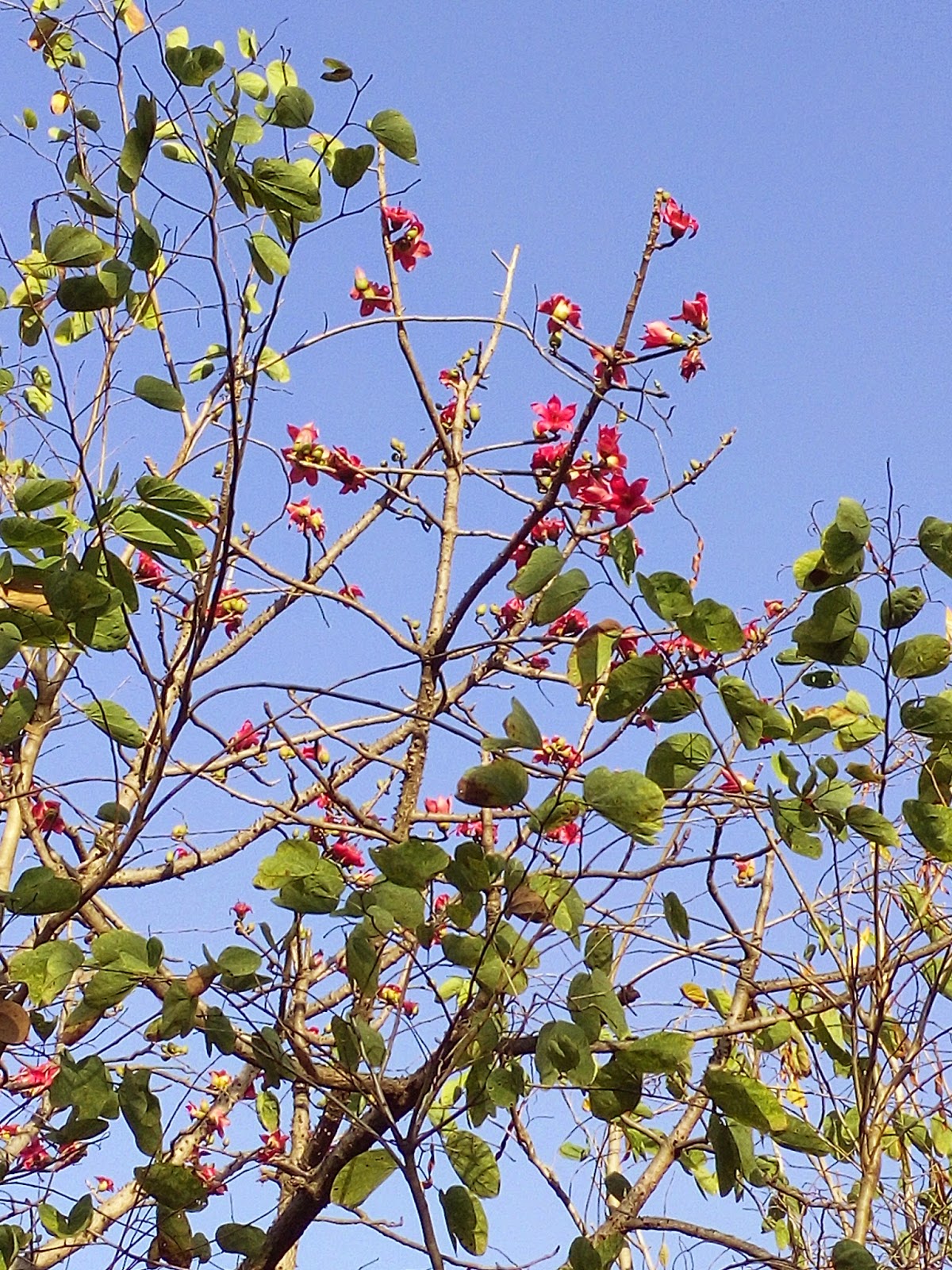
On one fine day you notice these beautiful Palaash or Palas (botanical name- Butea monosperma, also called Flame of the forest ) flowers. Here too the contrast in the background of the dry, brown coloured shrubs is remarkable. 
Palas


And then you realize that there are patches in the area which have this tree in predominance. What a view it would be if someone could take aerial photos of these flamboyant trees! 
Pangara

Palaash, Katesavar (or Bombax malabaricum or Silk cotton tree) & Pangara (or Erythrina indica or Indian coral tree) are probably the early messengers signalling the end of winter & beginning of Spring or Vasant Rutu.


Kate savar


I think so as to announce the arrival of spring as far as they can, these trees are studded with bright coloured flowers & virtually no leaves.As if taking cue from these messengers, suddenly there is lot of bustling activity, restless enthusiasm all around. The silence of the winter is soon a thing of the past. The birds shed all their boredom & soon there are calls of all sorts  from all directions. The forced break to their voices has worked wonders it seems.
You hear  the carefree, happy-go-lucky whistle of oriental Magpie Robin first & then you locate it somewhere on the tree top. This bird with its shiny, black & white looks,  is singing merrily & uninhibitedly. The whistle of an Iora is somewhat different. It is as if some college going youth is calling his friend (not necessarily a girl friend!) & asking to come out in the window.
The arrival of Spring has made some birds really bold. Those who would otherwise prefer to be camouflaged & only to be heard than seen, also venture out in the open. Coppersmith Barbet is the case in point. Here is he coming out of hiding, sitting perched on a horizontal branch of a tree. He is using it like a dais & giving us,the captive audience, an incessant & repetitive speech of his calls! 


Coppersmith Barbet
Photo courtesy- Vivek Joshi

These days we are seeing many birds that we hadn't seen  before. May be we were not coming here often during this time of the year or may be we were not keenly observing them. But better late than never, it is indeed a treat to your eyes & ears to see such wonderful birds. And I am not even considering peacocks here. We have been rewarded with sightings of Minivets & our favourite Paradise flycatchers on a regular basis.
Paradise Flycatcher
Photo courtesy -Vivek Joshi

Another bird to be seen usually is the spotted owlet. It is remarkable that we see the bird around the same spot whenever we go there.  It is seen around this dilapidated structure-either on the roof or on one of the branches of the Neem tree. 


This empty, broken structure is actually fit for shooting of a horror movie. The owlet would only add to the scary atmosphere!
A surprise sight these days is that of Common hawk Cuckoo or Brain fever bird or Pavsha in Marathi. I thought usually it is seen/ heard in the month of May, when the rainy season is just round the corner. In fact it gets its Marathi name because of  that. But I was wrong. I checked to find that it is seen in hot weather. Its call is fantastic.Its call could be interpreted as - perte vha...perte vha.... It as if tells the farmers to start preparing the farmland for the crops as rains could just be round the corner. But the English name of Brain fever is simply not fair. It means the calls are irritating. We have never imagined that this bird can be irritating.  Can the calls be electrifying? You can hear  from so far away & this call draws you towards the bird. It is that mesmerizing! The bird has obliged us not just with its calls but we have also been able to see it for a pretty long time. For a bird not even bigger than a pigeon, the calls are really of high frequency. These calls make me nostalgic & takes me back to the jungles of Dandeli when we had heard them for the first time. Those calls still ring in my ears! Funnily enough,the Koel, not wanting to be left behind, also joins the party.

The exuberance, the extravagance & the flamboyance seen or heard everywhere is not without a purpose.The Spring has in store immense possibilities. It is a season of not just rejuvenation but also regrowth & regeneration.The Spring ushers in breeding season for many birds. All this fuss by the birds- their calls & their appearances-is about getting noticed. So all the eligible candidates for this year are in a hurry to prove their worthiness & be the Chosen One!